Aspiration technique
Tip immersion depth matters. DRD studies show that excessive submersion can increase aspirated volume through hydrostatic effects.
Applications & Science
Explore application results and technical studies behind Differential Pipetting™—from 0.5 µL NGS preparation to nanoliter measurement, contact-free delivery, and comparisons with conventional pipettors.
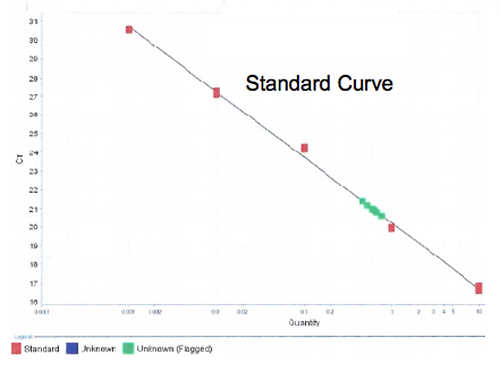
Application 01 · Next-generation sequencing
A Tufts University core facility used the DRD Differential Pipettor to deliver 0.5 µL NaOH contact-free during Illumina sample preparation—an example of precise transfer where reagent cost, contamination, and repeatability matter.
Discuss an NGS workflow“We find it easy to use and very reliable as well as very accurate at low volumes. The contact-free dispensing is a nice feature.”
Tufts University core facility · reported customer feedback

Research themes
The study series moves from technique fundamentals to comparative performance and the mechanics that make contact-free delivery possible.
Tip immersion depth matters. DRD studies show that excessive submersion can increase aspirated volume through hydrostatic effects.
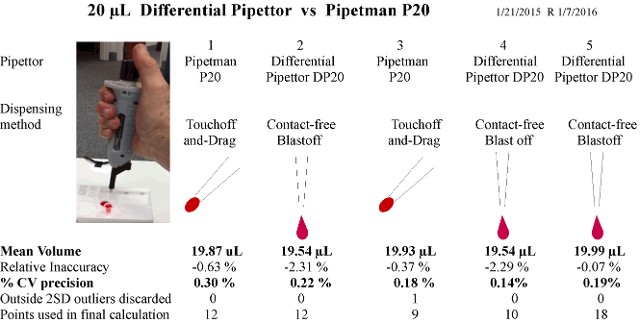
Blastoff dispensing avoids the angle, distance, and surface-contact variables introduced by touch-off-and-drag workflows.
Comparative studies span microliter and sub-microliter volumes, including external correlation with Artel measurement systems.
Clean release and fewer technique-dependent steps can support faster training, easier automation, and more reproducible transfers.
Featured findings
Selected highlights from the legacy DRD science collection, reorganized around the practical questions labs ask.
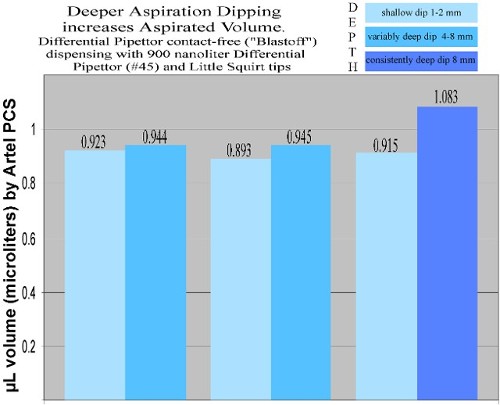
Deeper immersion can increase the aspirated amount as hydrostatic pressure adds liquid beyond the intended displacement.
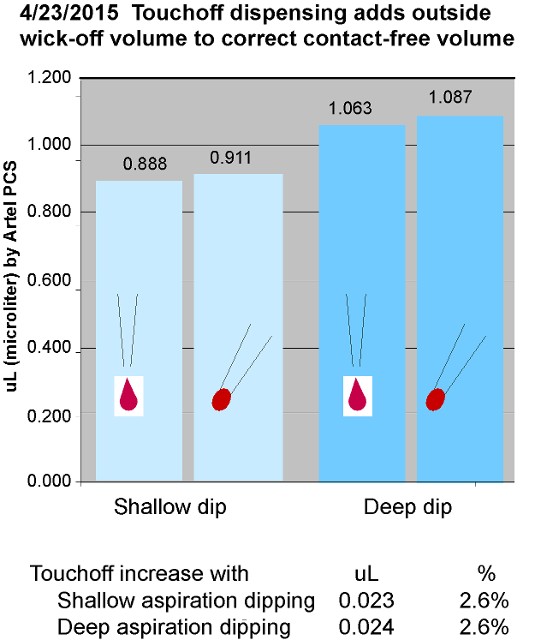
Wick-off from the tip can introduce extra liquid and another operator-dependent variable.
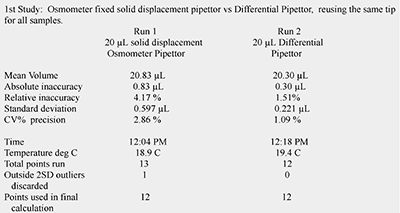
Artel-based testing examined accuracy at volumes where technique and clean release become especially consequential.
Testing from 10 µL through 0.75 µL compared Differential Pipetting with leading Gilson and Rainin instruments.
Claims summarize studies presented in DRD’s legacy science archive. Study conditions vary; application-specific validation is recommended.
Technical archive
Scan the complete collection by question, then contact DRD for study files or help applying the findings to a workflow.
Why the recommended 1–2 mm tip immersion helps avoid hydrostatic over-aspiration.
Contact-free Blastoff compared with conventional touch-off-and-drag technique.
How accurate low-volume pipetting supports next-generation sequencing workflows.
Measured wick-off contribution at approximately 1 µL delivery volumes.
Differential Pipettor performance compared with an expert using a Pipetman P20.
Practical workflow benefits beyond high-precision applications.
One hundred data points compared with leading manual pipettors, with no reported outliers.
A 1 µL coefficient of variation improved to 1.5% after correcting aspiration depth.
Sub-microliter comparison highlighting contact-free accuracy and reduced technique dependence.
Using non-differential mode when higher flow is useful for mixing.
Artel PCS correlation with no reported statistical outliers in the study set.
How two piston diameters address the traditional resolution-versus-flow tradeoff.
A consolidated review of precision, accuracy, speed, and ease across the study series.
A perspective on giving operators robot-like repeatability while preserving manual flexibility.
Why fewer failed transfers can reduce repeat work, stress, time, and material consumption.
The mechanism behind the data
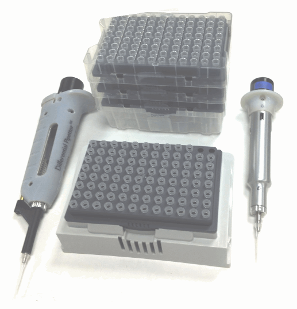
Differential Displacement™ uses two pistons of different diameters to make the net displacement small while preserving useful piston travel. The same system can then generate the flow needed for clean, contact-free dispensing.
Bring us your application