01
1980s
Analyzer innovation at AMDEV
AMDEV built a successful diagnostics business around innovative ion-selective electrode technology, direct field demonstrations, global dealers, and early OEM relationships.
The history of Differential Pipetting™
DRD’s story begins with a need to meter a tiny pediatric sample and a much larger reagent volume reliably. The answer—a two-piston differential mechanism—grew from one analyzer pump into a platform spanning manual pipetting, automation, and OEM integration.
The problem that started it
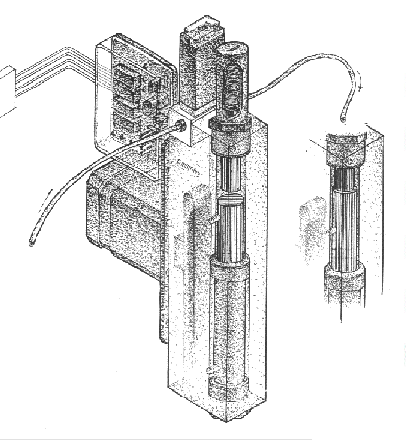
APEC’s glucose analyzer was intended to work with a 10 µL sample so it could support pediatric diagnostics. The assay also required a large reagent dilution. At the time, that combination would normally demand separate large- and small-syringe drives.
Founder Donald Schwartz challenged VP of Engineering Humayun Qureshi to meter the small sample without a tiny plunger or seal. The resulting two-piston pump used the difference between piston diameters to create fine displacement while retaining a robust larger-scale mechanism.
Fine metering did not have to depend on a fragile small piston.
The central engineering insight behind DRD
Innovation timeline
The history is less a sequence of unrelated instruments than the continued application of the same resolution-and-flow architecture.
AMDEV built a successful diagnostics business around innovative ion-selective electrode technology, direct field demonstrations, global dealers, and early OEM relationships.
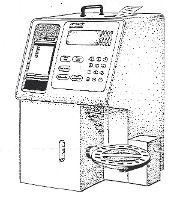
APEC set out to develop an enzyme-based glucose analyzer using a very small pediatric sample and a large reagent dilution—an awkward combination for conventional syringe systems.
Engineer Humayun Qureshi developed a pump whose piston-diameter difference provided fine metering without relying on a tiny piston or seal. It became the fluidic heart of the APEC Glucose analyzer.
DRD named the principles Differential Displacement and Dual Resolution. Pump modules were adopted for immunochemistry systems where range, flow, precision, reliability, and compactness had to coexist.
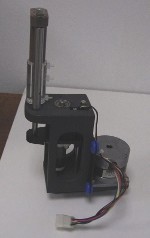
The core modules expanded into benchtop diluters, Robolab and Little Squirt systems, Dual Resolution Syringes, TITAN automation, and graphical control software.
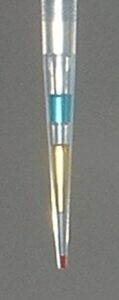
PipettorPlus and NEPTUNE96 applied the same principles to handheld and multichannel pipetting, adding accurate tiny-volume aspiration and contact-free delivery.
DRD now presents end-user instruments, automated 96-channel systems, programmable benchtop products, and OEM liquid-handling cores built around one patented mechanism.
OEM adoption
DRD’s modules addressed a recurring instrumentation problem: obtaining fine low-volume control, high flow, wide range, and reliability in a compact design.
The archived company history identifies Sanofi Diagnostics Pasteur as an early large customer and licensee, followed by embodiments used in immunochemistry analyzer programs associated with Beckman, Johnson & Johnson, and DPC Cirrus, later Siemens Medical.
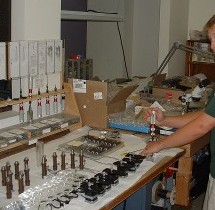
Platform evolution
DRD extended the core architecture across manual, benchtop, and automated formats rather than confining it to a single analyzer.
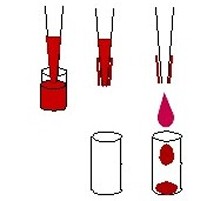
A flexible automation platform designed to accept DRD modules, pumps, and Dual Resolution Syringes under graphical control.

Self-contained systems paired core modules with an interactive probe, making tiny-sample pickup and contact-free delivery practical at the bench.
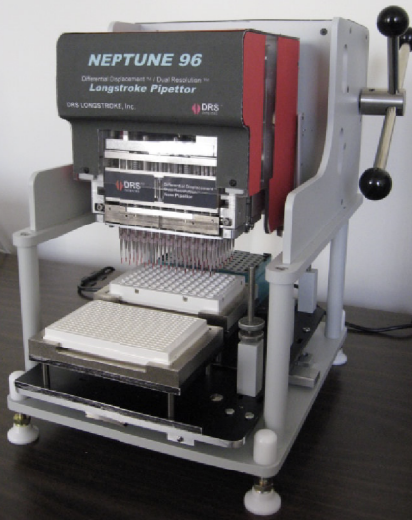
The same principles moved into air-filled, 96-channel pipetting and evolved toward today’s high-throughput product pathway.
The constant across every generation
Two pistons of different diameters create fine effective resolution when moved together. Independent movement preserves the high-flow capability needed for priming, mixing, and clean contact-free dispensing.
Explore the ScienceThe story now
Today’s DRD journey connects end-user instruments, OEM modules, scientific validation, and multiple partnership models around a protected core technology.
Continue the DRD story